


Smart Shopping Guide: Best Gadgets with Native AI for Your Home This Year
Until recently, for a device to be "smart," it needed to be connected to the cloud. If the internet went down, the intelligence disappeared. In 2026, we entered the era of On-Device AI. Now, processing happens within the device's own chip, bringing more speed, privacy, and impressive responsiveness. Se você está pensando em atualizar sua casa ou seu setup de trabalho, precisa saber quais gadgets realmente entregam essa nova geração de utilidade.
4/18/20262 min read
Why Local AI Processing is the New Privacy Gold Standard
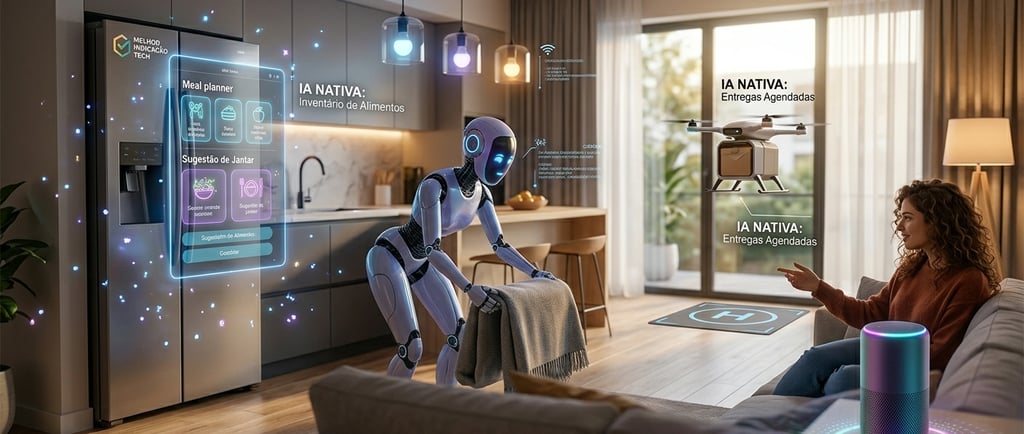
The major shift this year is that your data no longer needs to travel to an external server to be processed. With the new NPUs (Neural Processing Units) integrated into modern devices, AI can understand voice commands, recognize faces on security cameras, and translate languages in real-time—all locally.
This brings two massive benefits:
True Privacy: Your recordings and usage data stay inside your home.
Zero Latency: Responses are instant, as they don't depend on the quality of your internet connection. At Melhor Indicação Tech, we prioritize devices that function independently and securely.
Smart Appliances: What’s Actually Worth the Investment in 2026?
The "Smart Kitchen" has finally matured. Forget fridges that just show photos; this year’s highlights are:
Computer Vision Ovens: They identify the food you place inside and automatically adjust the cooking time and temperature, monitoring texture to prevent the food from drying out.
Washing Machines with Fabric Sensors: Equipped with infrared sensors and AI, they detect not just the weight, but the type of fiber and the soil level. This saves up to 40% in water and energy by customizing the cycle in real-time.
Robot Vacuums with Semantic Mapping: Unlike older models that simply "avoided" objects, 2026 models understand context. They know the difference between a pet toy (which can be moved) and a liquid spill (which requires a specific cleaning mode).
Smartphones & Laptops: The Difference Between a Standard Device and an AI PC
If you are upgrading your laptop or phone this year, the terms you’ll see most are AI PC or AI Phone. But what does that mean in practice?
An AI PC doesn’t just rely on the standard processor (CPU) and graphics card (GPU); it features dedicated hardware to run language models and image editors locally. Imagine subtitling a video call in real-time or generating meeting summaries without draining your entire battery—that is the power of next-gen NPUs.
In smartphones, native AI now manages energy consumption predictively. It learns your routines to ensure the battery lasts exactly when you need it most, while offering photo and video editing capabilities that were previously only possible in professional studios.
Buying Tip: When choosing your next gadget, check if it supports local AI models (such as Llama or Gemini Nano). This ensures your investment won't become obsolete in a few months and gives you total control over your digital privacy.