


The Tech Career Survival Guide: Skills AI Can't Replicate
The technology market in 2026 faces a paradox: it has never been easier to create code or automate processes, but it has never been more challenging to stand out as a professional. With AI taking over Level 1 Support tasks, basic coding, and simple data analysis, many are asking themselves: "What is my place in this new ecosystem?" A resposta não está em competir com a máquina em velocidade, mas em dominar o que é exclusivamente humano. No Melhor Indicação Tech, exploramos como você pode transformar a IA em sua maior aliada, focando nas competências que nenhum algoritmo consegue processar.
4/18/20262 min read
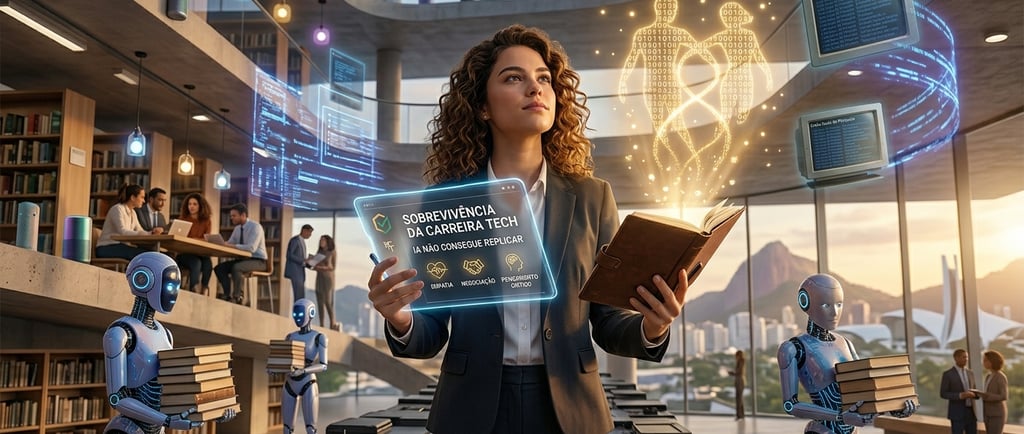

Soft Skills: The Competitive Edge in an Automation-Saturated Market
While AI is excellent at providing answers, it still fails to grasp the nuances of human relationships. Skills that were once viewed as "secondary" are now at the core of professional survival:
Empathy and Humanized Service: In technical support and customer success, the ability to calm a frustrated user and understand the emotional impact of a technical issue is something that a chatbot—no matter how advanced—cannot replicate authentically.
Negotiation and Persuasion: Tech projects aren't just made of code; they are made of people with differing interests. Knowing how to sell an idea, negotiate deadlines, and align expectations among stakeholders is a purely human art.
Complex (Contextual) Problem Solving: AI solves the problem you describe, but a human identifies the problem that no one has seen yet, connecting the dots between departments that the machine cannot access.
How to Use AI to Accelerate Your Career Transition in Tech
Rather than fearing replacement, the highest-paid professionals of 2026 are using AI as an "exoskeleton" for their skills. If you are a Support Analyst or a Junior Developer, here is how to evolve:
Learn Orchestration, Not Just Execution: Don't spend hours writing basic scripts. Use AI agents to generate the foundation and focus on how those scripts integrate into the company's ecosystem.
Specialize in Data Curation: The new role of the technician is to validate whether AI-generated output is safe, ethical, and efficient. Developing a "clinical eye" to review machine-generated work is one of the fastest-growing job functions.
Master Low-Code/No-Code Tools: Use platforms like Flutter or n8n to build complete solutions in record time. The speed AI provides allows you to focus on the solution architecture rather than just the syntax.
Critical Thinking and Curation: The Professions of the Near Future
The surplus of AI-generated information has created a new problem: digital pollution. Because of this, the skill of Curation has become vital. Companies need professionals who know how to filter what is relevant from what is simply an "AI hallucination."
Critical Thinking stands as the final line of defense. Questioning the "why" behind an algorithm-suggested decision and understanding the ethical and security implications of an integration is what separates a tool operator from a Technology Strategist.
In 2026, a tech career doesn't require you to know everything, but rather to know how things connect and how to ensure that technology serves a human purpose—not the other way around.
Career Tip: Invest time in learning system architecture and project management. The more "macro" your vision is, the less replaceable you will be by the "micro" processing of AI.